 Skip to content
Most Denver homeowners pay between $8 and $18 per square foot for a fully installed hardwood floor, materials and labor combined, according to Realtor. Your final number depends mostly on the wood species you pick, the condition of your subfloor, and the finish you choose. Before you commit to a budget, get two or three written quotes from local pros so you’re comparing real numbers, not guesses.
TL;DR:
- Most Denver hardwood installation costs range from $8 to $18 per square foot, heavily influenced by wood species, finish, and subfloor condition.
- Engineered hardwood often costs less than solid wood and handles Denver’s seasonal humidity better, with prefinished options reducing installation time.
- Properly detailed quotes include material grades, installation method, subfloor prep, and finishing, avoiding low-ball bids that omit crucial costs.
- Refinishing existing hardwood floors can recover up to 147% of the project costs at resale, making it a more valuable investment if floors are solid and minimally damaged.
- A typical 1,000-square-foot project in Denver costs between $8,000 and $18,000, depending on choices, with accurate estimates requiring precise measurements and substantiated bids.
Table of Contents
- What hardwood installation typically costs in Denver
- What you’re actually paying for: a cost breakdown
- How to get a quote you can actually trust
- How long a Denver hardwood project actually takes
- Refinish or replace: how to decide
- Resale value and the formaldehyde rule you should know about
- How we price, schedule, and guarantee Denver jobs
- When hardwood installation is the right investment
- How J.R. Hardwood Floor Refinishing & Cleaning can help
- Sources
- FAQ
What hardwood installation typically costs in Denver
Think of your flooring budget in three tiers, the same way you’d shop for a car: there’s the reliable base model, the comfortable mid-range pick, and the splurge-worthy upgrade. All three can look beautiful in a Denver living room, but the price tags are very different.
On the low end, you’re looking at around $8 to $10 per square foot installed. That usually means a budget-friendly species like red oak, a basic nail-down installation, and a straightforward site-finished polyurethane coat. Mid-range jobs land closer to $11 to $14 per square foot, often featuring a wider plank, a premium stain, or an engineered hardwood product that handles Colorado’s dry air a little better. At the top end, $15 to $18 per square foot or more covers exotic species, custom patterns like herringbone, or specialty finishes such as a UV-cured topcoat.
To put that in real-world terms, here’s how those per-square-foot bands translate into sample project totals:
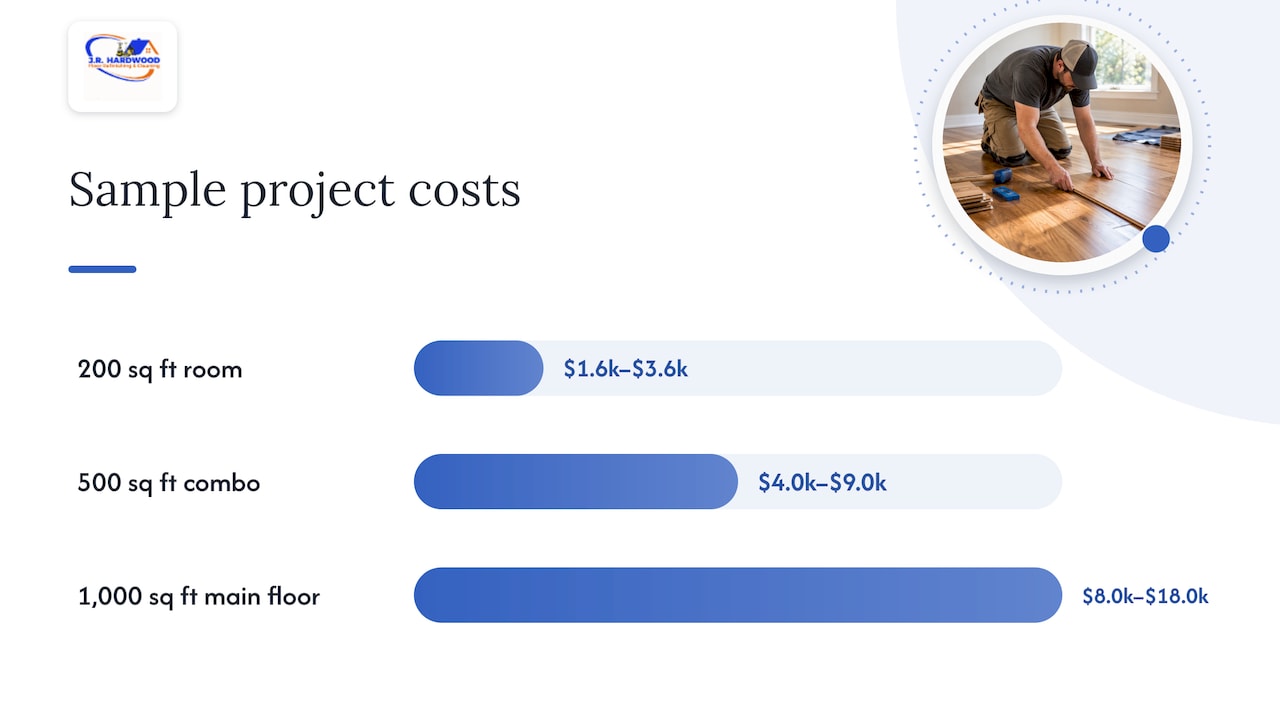
- A 200-square-foot bedroom or home office runs roughly $1,600 to $3,600 installed, a manageable weekend-sized project for many homeowners.
- A 500-square-foot living and dining combo typically lands between $4,000 and $9,000, depending on species and finish.
- A 1,000-square-foot main floor, common in many Denver bungalows and split-levels, usually falls between $8,000 and $18,000.
Species drives a surprising amount of that spread. Red and white oak remain the most budget-friendly options because they’re widely available and easy to work with. Hickory and maple sit a notch higher, prized for their durability in high-traffic homes. Walnut, cherry, and imported exotics like Brazilian cherry push costs up fastest, both because the raw material costs more and because some species are harder on saw blades and installation time. Engineered hardwood, which pairs a real wood veneer with a stable plywood core, often costs slightly less than solid hardwood of the same species and tends to handle Denver’s seasonal humidity swings with less gapping or cupping.
Product type matters just as much as species. Prefinished planks arrive from the factory already sanded and sealed, which shortens your installation timeline. Site-finished floors get sanded and coated after the wood is down, which takes longer but allows for a more seamless, uniform look across the whole room. Both are good options, and the better fit depends on your timeline and how much disruption you’re willing to tolerate.
For a deeper look at how these price drivers shake out for Denver-area projects specifically, our average cost to install hardwood floors page walks through more sample scenarios.
What you’re actually paying for: a cost breakdown
A hardwood quote isn’t just one number. It’s a stack of smaller line items, and understanding each one helps you spot a fair bid from a confusing one.
Materials make up a big chunk of the bill. Grade matters here: “select” grade boards have fewer knots and a more uniform look, while “rustic” or “character” grades include more natural variation and often cost less. Species, as covered above, swings material costs the most.
Labor depends on installation method. Nail-down installation is the traditional approach for solid hardwood over a wood subfloor, and it’s often the most economical labor method. Glue-down installation, common for engineered hardwood over concrete, requires more prep and careful adhesive work. Floating floors, which click together without nails or glue, install fastest but aren’t always the best long-term choice for a primary living space.
- Subfloor repair or leveling can add real cost if your existing floor has soft spots, squeaks, or uneven areas.
- Moisture mitigation, especially common in older Denver homes with basements or slab foundations, may require a vapor barrier before installation begins.
- Demolition and haul-away of your old flooring, whether that’s carpet, tile, or worn-out wood, is often billed separately.
- Stairs and transitions between rooms or flooring types typically carry their own per-piece or per-linear-foot pricing.
Finishes and extras round out the bill. Custom stain colors, decorative inlays, herringbone or chevron patterns, and stair nosing all add labor time and material cost. None of these are required, but they’re worth asking about upfront so they don’t show up as a surprise line item later.
One common blind spot: low per-square-foot quotes in some local listings start around $2 to $4 for labor alone, but that figure almost never includes materials, prep, or finishing. A complete, apples-to-apples installed price nearly always lands in the higher bands described above.
How to get a quote you can actually trust
A good quote starts with good information. The more detail you give a contractor upfront, the more accurate and comparable your bids will be.
- Measure your square footage as precisely as you can, or provide room dimensions so a contractor can calculate it.
- Take clear photos of your current flooring, including any damage, stains, or uneven spots.
- Note your subfloor type: wood, concrete slab, or something else, since this affects installation method.
- Describe your desired finish, whether that’s a matte site-applied polyurethane, a glossy prefinished plank, or a fast-curing UV topcoat.
- Mention any known issues, like squeaky boards, past water damage, or pets that might affect material choice.
Once you’ve got a quote in hand, run it through a short checklist before signing anything. Ask whether the contractor carries liability insurance and is properly licensed in Colorado. Ask what warranty covers the installation itself versus the materials. Ask who handles daily cleanup and dust containment, and get the payment schedule in writing, including when deposits are due and what triggers the final payment.
Pro Tip: Ask every contractor the same five questions in the same order. It makes side-by-side comparison much easier when the bids come back looking different on paper.
Watch for a few red flags. A quote that’s dramatically lower than the others you received often means something’s missing, usually prep work, disposal, or finish coats. Vague language around “standard installation” without specifics on method or materials is worth questioning. And any contractor unwilling to put the warranty or payment terms in writing should raise a flag before you sign anything.
How long a Denver hardwood project actually takes
Hardwood installation isn’t a one-day job, and setting the right expectations upfront makes the whole process much less stressful.
- Solid hardwood generally needs several days of acclimation in your home before installation, letting the wood adjust to indoor humidity; engineered hardwood needs less acclimation time.
- Installation itself typically takes one to three days depending on square footage and pattern complexity.
- Site-finished floors need additional time for sanding and multiple coats of finish, often adding two to four more days.
- Walk-on time varies by finish type: many prefinished and UV-cured products allow same-day or next-day light foot traffic, while traditional site-applied polyurethane often needs 24 to 48 hours or more before furniture goes back.
Dust containment deserves its own line in your contract. Quality installers use containment barriers and dust-collecting sanders to keep the mess confined to the work area rather than drifting through your whole home. Ask for this in writing, along with a daily cleanup commitment, so you know exactly what to expect each evening of the project.
Colorado’s dry climate adds its own wrinkle. Because humidity here swings more than in coastal regions, acclimation time really does matter for solid hardwood. Scheduling your install for a season with more stable indoor humidity, and avoiding extreme cranking of your furnace or humidifier right before the crew arrives, helps prevent gapping or cupping down the road.
Refinish or replace: how to decide
Sometimes the floor you already have just needs a refresh, not a full replacement, and the cost difference between the two is significant enough to warrant a real second look before you commit to tearing anything out.
Refinishing an existing hardwood floor typically costs a fraction of new installation, since you’re paying for sanding and a fresh finish rather than new materials and full labor. New hardwood installation, by comparison, lands in the $8 to $18 per square foot range discussed earlier.
- If your existing floor is solid hardwood with surface scratches, dullness, or minor staining, refinishing is almost always the more cost-effective route.
- If boards are cupping, warping, or showing signs of water damage down to the subfloor, replacement in that area, or the whole room, becomes the more reliable fix.
- If you’ve got engineered hardwood with a thin veneer that’s already been sanded once or twice, there may not be enough wood left to refinish safely, and replacement is the better call.
Partial replacement is worth considering when damage is localized, like near a leaky dishwasher or a sliding door threshold, rather than spread across the whole room. Engineered planks are a smart substitute when you want the look of hardwood in a space with higher moisture exposure, like a finished basement. For everything else, a straightforward hardwood floor refinishing often delivers the glow-up you’re after at a lower cost than starting from scratch.
Resale value and the formaldehyde rule you should know about
Hardwood floors remain one of the more reliable investments you can make in a home, and the numbers back that up. Refinishing an existing hardwood floor can recover up to 147% of its project cost at resale, while installing brand-new wood flooring recovers closer to 118%, based on industry remodeling reports. That gap is worth remembering: if your existing floors are solid wood and just need attention, refinishing often delivers a better return than ripping them out.
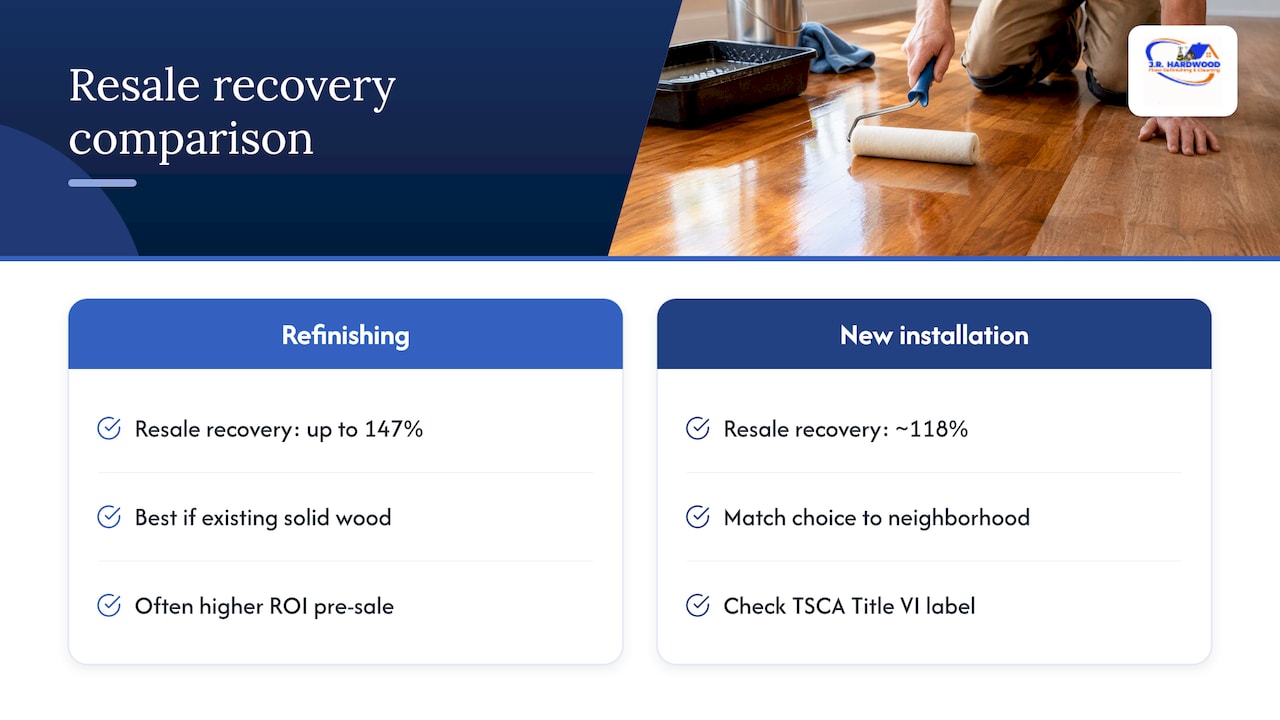
Refinishing’s resale recovery can reach 147% of cost, compared to roughly 118% for new hardwood installation, according to Opendoor’s breakdown of flooring ROI, meaning a well-timed refresh can be one of the smarter moves on your pre-sale checklist.
One regulatory detail worth knowing before you buy composite wood products: the EPA’s TSCA Title VI formaldehyde standard sets emission limits for composite wood products like plywood underlayment and engineered flooring cores. When you’re shopping materials, ask your supplier or installer whether the product is labeled TSCA Title VI compliant. It’s a simple question that protects your indoor air quality without adding cost to your project.
Matching your material choice to your neighborhood matters too. A $15-per-square-foot exotic hardwood might not pay back in a starter-home neighborhood the way it would in a higher-value area, so it’s worth weighing your investment against comparable homes nearby before splurging on the top tier.
How we price, schedule, and guarantee Denver jobs
We start every project the same way: a free quote based on a phone call and a few photos of your floors. No pushy sales visit required. Tell us your square footage, what you’re hoping to achieve, and send a couple of clear pictures, and we’ll give you a realistic estimate before we ever set foot in your home.
Once a job is booked, we treat dust control as a given, not an upsell. Our sanding equipment captures the vast majority of dust at the source, and we use eco-friendly finishes that cut down on strong odors lingering in your home afterward. For homeowners who need a faster turnaround, our Instant UV-curable finish allows walking on the floor the same day, a real advantage for busy households or properties being prepared for a quick sale.
We serve the Denver Metro Area along with Parker, Castle Rock, Boulder, and Colorado Springs, so wherever you are along the Front Range, there’s a good chance we’re already working nearby. Every consult includes honest guidance, including telling you when your floors don’t actually need full replacement. If a screen and recoat or a thorough clean and buff will get you the result you want, we’ll say so.
When hardwood installation is the right investment
Here’s where I’ll push back on the usual advice a little: new hardwood installation isn’t automatically the smarter move just because it’s the flashier one. If your existing floors are solid wood underneath a dated finish, refinishing almost always makes more financial sense, and the resale numbers above back that up.
New installation earns its cost when you’re dealing with carpet, damaged subflooring, or a layout that never had hardwood to begin with. It also makes sense if you’re planning to stay in the home long enough to enjoy it, not just flip it for a quick sale. Watch your neighborhood comps before choosing a premium species. A tasteful, well-installed mid-range floor in a home that matches its block will usually outperform an expensive statement floor that doesn’t fit the market.
— J.R.
How J.R. Hardwood Floor Refinishing & Cleaning can help
J.R. Hardwood Floor Refinishing & Cleaning is a locally owned floor care specialist serving the Denver Metro Area and surrounding Colorado communities. The company provides comprehensive residential and commercial services, including hardwood refinishing, full sanding and restoration, screen and recoat, clean and buff, wax removal, Instant UV-curable finishing, and full installation of hardwood, LVP, and laminate. Customers receive free over-the-phone quotes based on verbal information and photos, clear scheduling, and expert guidance tailored to each floor’s condition.

Whatever stage your project is at, there’s a service built for it:
- Hardwood Floor Installation for new flooring projects, including hardwood, LVP, and laminate options.
- Full Sanding & Refinishing, priced between $4.20 and $5.50 per square foot, for floors that need a complete reset.
- Screen & Recoat, starting at $2.50 per square foot, for floors that just need a faster surface refresh.
- Instant UV-Curable Finish for homeowners who need a same-day walk-on finish without sacrificing durability.
Getting started is simple. Call us or send a few photos of your current floors along with your square footage, and we’ll put together a free quote based on what you share, no in-person visit required just to get a number. Using eco-friendly products and premium finishes, our team removes dirt, grime, scratches, and wear to protect your floors and extend their life while elevating the look of your home. With 5-star reviews across multiple platforms and detailed YouTube videos showing our process from start to finish, you can see exactly what to expect before we ever arrive.
Ready to get your number? Visit our hardwood flooring services page to request your free quote today.
Sources
- Do hardwood floors increase home value? — Opendoor
- Frequent questions for consumers about the Formaldehyde Standards for Composite Wood Products Act — US EPA
- Realtor
FAQ
How much does it cost to install 1,000 square feet of hardwood?
A 1,000-square-foot installation in Denver typically costs between $8,000 and $18,000, based on typical per-square-foot installed pricing. The final number depends heavily on species choice, subfloor condition, and whether you choose a prefinished or site-finished product.
How much does Home Depot charge to install hardwood?
Home Depot and other big-box retailers typically connect homeowners with third-party installation partners rather than performing the work directly, and pricing varies by local contractor and project scope. For an accurate number, it’s worth comparing a big-box quote against a local specialist’s written estimate covering the same materials and prep work.
How much is hardwood flooring for a 2,000-square-foot house?
Using the per-square-foot bands discussed earlier, project costs vary widely depending on home size, species choice, and finish type, which are the biggest factors influencing price differences, based on Realtor.com’s installed pricing ranges.
What flooring adds the most value to a house?
Hardwood consistently ranks among the flooring types most likely to support a strong resale outcome, with refinishing existing hardwood recovering up to 147% of its cost and new hardwood installation recovering roughly 118%, according to industry ROI data. Choosing a species and finish that matches your neighborhood’s comps tends to matter as much as the material itself.
Should I refinish my existing floors instead of installing new hardwood?
If your current floors are solid hardwood with only surface wear, refinishing is usually the more cost-effective choice and often delivers a stronger return than full replacement. Floors with water damage, deep warping, or a worn-out veneer on engineered wood are better candidates for replacement.